← Back to the testPrint answer keyTip: in the print window choose “Save as PDF” to keep a copy.
Beyond Young Academy crest
Beyond Young Academy
Crescat Scientia

BY Original Practice Test 1

ISEE Lower Level (grades 4–5) · Verbal Reasoning 20 min · Quantitative Reasoning 35 min · Reading Comprehension 25 min · Mathematics Achievement 30 min · Essay 30 min

Beyond Young Academy practice test. Not an official ISEE form; scores here are not ERB scores.

Name:Date:Score:
Verbal Reasoning34 questions20 minutes
Quantitative Reasoning38 questions35 minutes
Reading Comprehension25 questions25 minutes
Mathematics Achievement30 questions30 minutes
EssayUnscored30 minutes

Work one section at a time and keep to its time limit. Mark answers on the answer sheet at the back.

isee.beyondyoung.org

Verbal Reasoning · 20 minutes · 34 questions

1.

AMPLE:

Aenormous
Bplentiful
Cexcellent
Dspacious
2.

HUMBLE:

Apoor
Bquiet
Cmodest
Dshy
3.

VACANT:

Acracked
Bdirty
Cunlocked
Dunoccupied
4.

ADJUSTMENT:

Aaddition
Brefusal
Calteration
Drepair
5.

HASTY:

Arushed
Bcareless
Cconfident
Dearly
6.

SCARCE:

Aplentiful
Bscant
Ccranky
Ddainty
7.

FRAGILE:

Adelicate
Bsturdy
Cbare
Dstiff
8.

PLUMMET:

Afloat
Bspin
Cdrop
Dstumble
9.

AJAR:

Aopen
Bunlocked
Chidden
Dnarrow
10.

CONCEAL:

Adestroy
Bshield
Chide
Dstore
11.

BLUNT:

Aheavy
Bdull
Crude
Dsharp
12.

STERN:

Aangry
Bsilly
Cstrict
Dweak
13.

NIMBLE:

Aagile
Bclever
Cstrong
Dsmall
14.

DILIGENT:

Aintelligent
Bpatient
Ctalented
Dhardworking
15.

MEEK:

Abold
Bcranky
Crestless
Dgentle

Go on to the next page.

16.

DEFY:

Adeny
Bresist
Ccopy
Dobey
17.

WEARY:

Atired
Brestless
Clazy
Dnervous
18.

Before the concert began, the auditorium buzzed with a ------ jumble of instruments tuning, chairs scraping, and audience members murmuring all at once.

Aenergetic
Bchaotic
Charmonious
Dsolemn
19.

The morning fog ------ as soon as the bright sun rose above the hills, leaving the valley clear and easy to see.

Alingered
Bthickened
Cvanished
Darrived
20.

The two neighbors argued over the fence for months, but a patient mediator finally helped them ------ a fair agreement both sides could accept.

Aabandon
Bdelay
Creach
Ddispute
21.

Because the coach believed daily practice ------ excellent performance, she required the team to run drills every single afternoon.

Adelays
Bprevents
Creplaces
Dfosters
22.

The prolonged drought ------ the region's crops, leaving farmers with fields of dry, brittle stalks instead of a healthy harvest.

Anourished
Bdevastated
Cprotected
Dwatered
23.

The trail near the summit looked ------ on the map, but hikers found it required careful footing over loose, jagged rocks.

Agentle
Brugged
Csteep
Dtreacherous
24.

After decades of nobody visiting, the attic was filled with ------ furniture covered in thick layers of dust and cobwebs.

Afragile
Bmodern
Cpolished
Dneglected
25.

The engineer designed the new bridge to ------ heavy loads of traffic without bending or cracking under pressure.

Aavoid
Bwithstand
Cdiscard
Dweaken
26.

Because the gardener forgot to water the tomato plants for two weeks, the leaves began to ------ under the hot summer sun.

Abloom
Bripen
Csprout
Dwilt

Go on to the next page.

27.

Grandmother's stories about her childhood seemed ------, yet historians confirmed that many of the strange details were completely true.

Abelievable
Bboring
Cfar-fetched
Dordinary
28.

The city's new recycling program used colorful posters and small prizes to ------ residents into sorting their bottles and cans instead of throwing them in the trash.

Aentice
Bbully
Cforce
Dpressure
29.

By noon, the desert became so ------ that even the lizards sought shelter beneath the few available rocks.

Abreezy
Bscorching
Cdamp
Dfrigid
30.

The farmers' market on Saturday mornings was always ------, with vendors calling out prices and shoppers weaving between crowded stalls.

Adeserted
Bbustling
Corderly
Dtranquil
31.

Because the days grow shorter and food becomes scarce in autumn, many birds ------ to warmer regions where they can find enough to eat.

Ahibernate
Bnest
Cremain
Dmigrate
32.

Ms. Alvarez's voice was usually ------, but during the fire drill she shouted loud instructions to guide everyone outside safely.

Ahushed
Bbooming
Charsh
Dmonotone
33.

Although Marcus felt nervous about speaking in front of the class, he ------ his fear and delivered a confident presentation.

Aconquered
Bavoided
Cignored
Dincreased
34.

Because the professor spoke in a flat, ------ tone for the entire lecture, several students found it difficult to stay awake.

Amonotonous
Bbooming
Ccheerful
Denthusiastic

STOP. If you finish before time is called, check your work in this section only.

Quantitative Reasoning · 35 minutes · 38 questions

1.

A cookie recipe calls for 12 ounces of butter to make 1 batch. A baker wants to make 2 1/2 batches. How many total ounces of butter are needed?

A24 ounces
B28 ounces
C30 ounces
D36 ounces
2.

The temperature at 7 A.M. was 58 degrees Fahrenheit. By noon, the temperature had risen 17 degrees. By evening, it had dropped 9 degrees from the noon temperature. What was the temperature in the evening?

A66 degrees
B67 degrees
C75 degrees
D84 degrees
3.

Maria is building a fence around her garden. The total length of the fence is 12 yards. A wooden gate that is 2 feet 6 inches wide will be part of the fence. How many feet of the fence will NOT be the gate?

A30 feet
B33.5 feet
C35.5 feet
D36 feet
4.

A pitcher contains 2.5 liters of lemonade. Each glass holds 275 milliliters. How many full glasses can be poured from the pitcher?

A8 glasses
B9 glasses
C10 glasses
D7 glasses
5.

A rectangular classroom bulletin board is 15 feet long and 9 feet wide. Mr. Lopez wants to put a ribbon border around the entire edge of the board. How many yards of ribbon does he need?

A8 yards
B16 yards
C24 yards
D48 yards
6.

A garden hose is 27 feet long. Ben needs a hose that reaches at least 9 yards from the faucet to his garden. Is his 27-foot hose long enough?

ANo, because 9 yards equals 21 feet
BNo, because 9 yards equals 31 feet
CYes, because 9 yards equals 27 feet
DYes, because 9 yards equals 30 feet
7.

A pitcher contains 3 quarts of lemonade. Ben pours out 5 cups to serve his friends. How many quarts of lemonade remain in the pitcher? (4 cups = 1 quart)

A1 1/4 quarts
B1 1/2 quarts
C2 1/4 quarts
D1 3/4 quarts
8.

A ribbon is 5 yards long. It is cut into pieces that are each 1 foot 6 inches long. How many full pieces can be cut from the ribbon?

A6 pieces
B8 pieces
C10 pieces
D15 pieces

Go on to the next page.

9.

A jacket costs $60. The store is having a sale of 20% off. What is the sale price of the jacket?

A$40
B$52
C$48
D$12
10.

Ben has 3 quarters. What fraction of a dollar does he have?

A3/100
B1/4
C4/3
D3/4
11.

A ribbon is 7/8 of a yard long. Marcus cuts off 1/4 of a yard to use for a bow. How much ribbon is left?

A3/8
B6/8
C1/2
D5/8
12.

A movie is 3/4 of an hour long. How many minutes long is the movie?

A30
B40
C45
D15
13.

An eraser costs $6.85. Diego pays with a $10 bill. How much change should he receive?

A$3.25
B$3.15
C$4.15
D$2.15
14.

There are 24 students in Ms. Lee's class. Exactly 1/3 of the students play soccer after school. How many students play soccer?

A12
B6
C16
D8
15.

A book costs $50. Next month, the price will increase by 10%. What will the new price of the book be?

A$55
B$60
C$45
D$51
16.

A pizza is cut into 8 equal slices. Ana eats 3 slices and her brother Ben eats 2 slices. What fraction of the pizza is left?
A3/8
B5/8
C3/5
D2/8
17.

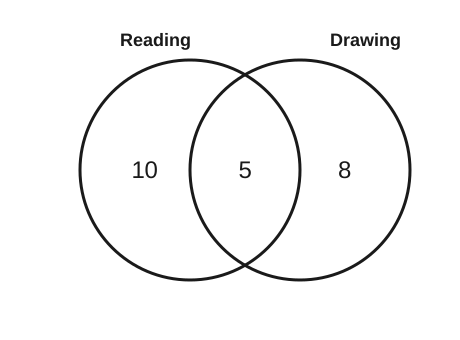
The Venn diagram shows how many students enjoy Reading and Drawing as hobbies. How many students in all enjoy Reading, Drawing, or both?

A18
B21
C23
D28

Go on to the next page.

18.

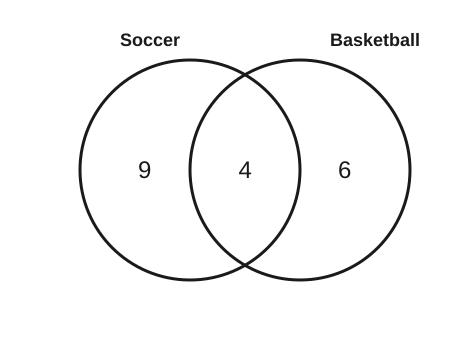
The Venn diagram shows the sports played by students in a class. How many students play BOTH Soccer and Basketball?
A4
B6
C9
D13
19.

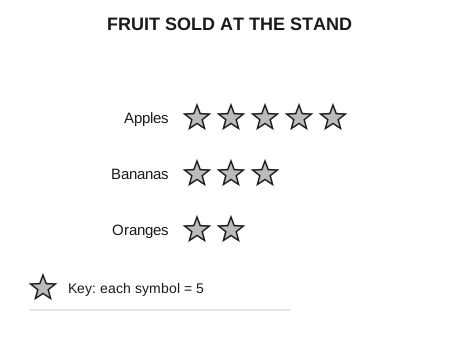
The pictograph shows the number of pieces of fruit sold at a fruit stand on Saturday. Each symbol stands for 5 pieces of fruit. How many bananas and oranges were sold combined?
A20
B25
C30
D35
20.

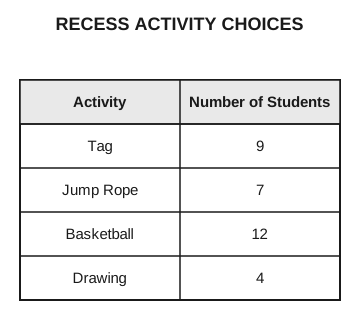
The table shows how students chose to spend recess. How many students in all were surveyed?

A28
B36
C21
D32

Go on to the next page.

21.

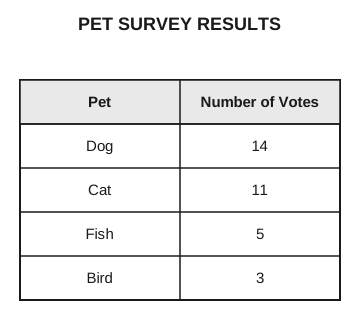
The table shows the results of a survey asking students which pet they like best. How many students voted for Dog?
A3
B5
C11
D14
22.

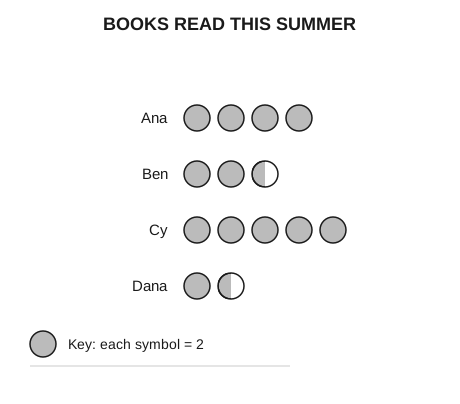
The pictograph shows the number of books each student read this summer. Each symbol stands for 2 books. How many books did Cy read?
A5
B8
C9
D10
23.

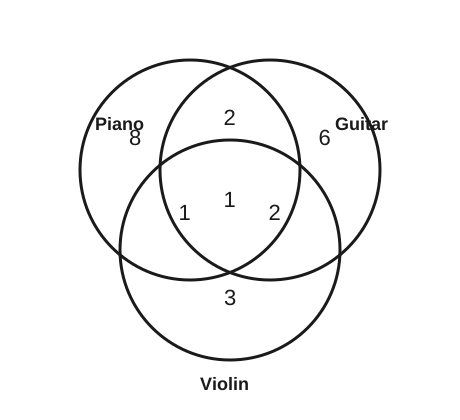
The Venn diagram shows which instruments students play: Piano, Guitar, and Violin. How many students play Guitar in total (including students who also play other instruments)?

A6
B9
C11
D14

Go on to the next page.

24.

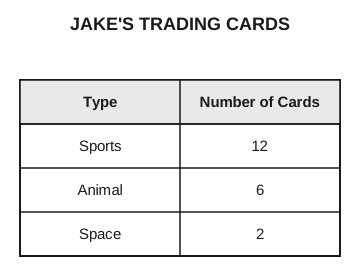
The table shows Jake's trading card collection. If Jake picks one card at random from his collection, what is the probability that it is a Space card?

A1/10
B1/6
C2/12
D1/2
25.

Using the digits 4, 7, and 2 each exactly once, Maria writes the largest possible 3-digit number and the smallest possible 3-digit number. What is the difference between her two numbers?

A468
B477
C495
D505
26.

A school is sending 245 students on a field trip. Each bus holds 40 students. What is the minimum number of buses needed so that every student has a seat?

A7
B6
C8
D5
27.

A bakery bakes 18 trays of cookies with 24 cookies on each tray. The bakery sells cookies throughout the day until 96 cookies remain. The remaining cookies are packed into boxes of 8. How many boxes are needed to pack all the remaining cookies?

A54
B42
C38
D45
28.

A city bus leaves a stop every 15 minutes, starting at 8:00 A.M. Which of the following times will the bus be at the stop?

A9:05 A.M.
B9:15 A.M.
C9:20 A.M.
D9:40 A.M.
29.

A classroom has a bag of stickers that the teacher wants to split evenly among 6 table groups, with none left over. Which number of stickers could be in the bag?

A242
B244
C246
D250
30.

A field trip costs $45 per person. There are 23 students and 4 adult chaperones going on the trip. What is the total cost of the trip?

A$1,035
B$1,170
C$1,260
D$1,215

Go on to the next page.

31.

Each of 5 classrooms uses about 812 sheets of paper in a month. Which is the BEST estimate of the total number of sheets used by all 5 classrooms in one month?

A4,060 sheets
B3,500 sheets
C4,000 sheets
D4,500 sheets
32.

A bakery has 612 rolls. After selling 195 of them, about how many rolls remain? Round each number to the nearest hundred before subtracting to find the best estimate.

A300
B500
C600
D400
33.

To find how many cups of flour a recipe needs, Jordan wrote the expression 6 + 3 x (8 - 5). What value does this expression represent?

A15
B25
C27
D9
34.

Mia is thinking of two odd numbers. If she adds them together, what kind of number will the sum always be?

AOdd
BPrime
CEven
DZero
35.

A submarine is at a depth of 120 feet below sea level, written as -120 feet. The submarine then rises 45 feet. What is its new depth, written as a negative number?

A-165 feet
B-75 feet
C-85 feet
D75 feet
36.

A number is even. If that even number is multiplied by any whole number, what can you say about the product?

AAlways odd
BCould be either odd or even
CAlways a multiple of 10
DAlways even
37.

A number is a multiple of both 4 and 6, and it is between 30 and 45. What is the number?

A32
B40
C36
D42
38.

Which list shows these numbers ordered from least to greatest: 0.6, 0.58, 0.65, 0.508?

A0.6, 0.58, 0.65, 0.508
B0.58, 0.508, 0.6, 0.65
C0.508, 0.58, 0.6, 0.65
D0.65, 0.6, 0.58, 0.508

STOP. If you finish before time is called, check your work in this section only.

Reading Comprehension · 25 minutes · 25 questions

Questions 1 – 5
1Old Mortimer the mole had the finest
2tunnels in all of Hollow Field, and he
3was proud of every one of them; he had
4dug each one straight and smooth. "A
5good tunnel never needs advice," he
6liked to announce. Whenever the young
7rabbits asked him how to dig, he only
8sniffed and went back to work. His
9tunnels were safe from the heat, the
10cold, and the hungry crows, but he
11seldom had a visitor.
12One gray evening, a sparrow named Pip
13landed on the fence post above his door
14and called down. "Mortimer! The sky in
15the north is nearly black, and I think a
16terrible storm is coming. You should
17leave for high ground tonight!" Mortimer
18did not even look up from his digging.
19"I have lived under this field for
20twelve years," he answered, "and a bird
21cannot teach a mole about the ground."
22Pip flew away sadly, and that night the
23rain came down in heavy sheets. Water
24rushed across the field and poured into
25the tunnels until cold mud covered
26Mortimer's feet and then rose above his
27knees. He scrambled up the nearest shaft
28and burst out into the wind, where he
29shivered beside the fence post, wet and
30alone.
31At dawn, Pip found him there. She could
32have said "I told you so," but she did
33not mention her warning at all. Instead
34she led him up the hill to an old stone
35wall, where the rabbits had built a dry
36nest of straw, and they shared their
37warm bed and a little clover with the
38miserable mole. Mortimer felt a lump in
39his throat.
40"Pip," he said quietly, "you were right,
41and I was foolish. I was so certain
42about my own tunnels that I refused to
43listen." Pip tilted her head and replied
44that everyone knows something, even
45about places where they have never
46lived. The next spring, Mortimer dug a
47new tunnel on the slope above the field,
48and when the young rabbits came with
49their questions, he put down his shovel
50and patiently answered every one.

Go on to the next page.

1.

Which sentence best states the main idea of the story?

ASmall birds are able to fly faster than any mole can dig.
BRabbits build safer homes on high hills than moles build below.
CEven an expert should listen when others offer useful advice.
DPeople survive storms best when they stay hidden underground.
2.

According to the passage, why did Mortimer refuse to move when Pip warned him?

AHe felt that a bird had nothing to teach a mole about the ground.
BHe had never noticed the dark clouds forming in the northern sky.
CHe was too busy teaching the young rabbits how to dig.
DHe thought the storm would turn away before reaching the field.
3.

Why most likely did Pip say nothing about her warning at dawn?

AShe had already forgotten the warning she gave the night before.
BShe was upset with him and wanted him to leave her alone.
CShe was worried that the rabbits might overhear her words.
DShe cared more about helping him than about being proven right.
4.

In line 27, the word "scrambled" most nearly means

Astrolled along calmly
Bhurried with effort
Cfell backward
Dwaited patiently
5.

Which pair of words best describes the tone of the story's final paragraph?

Abitter and very angry
Bfearful and tense
Cgentle and hopeful
Dsilly and playful

Go on to the next page.

Questions 6 – 10
1Bats are the only mammals that can truly
2fly, and many of them hunt for insects
3in complete darkness. A bat does not
4rely on its eyes to catch a moth at
5midnight. Instead, it uses a skill
6called echolocation. This works much
7like the sonar that ships use to explore
8the ocean floor.
9As a bat flies, it produces high squeaks
10with its mouth or nose, and the sounds
11are so high that human ears cannot hear
12them. The sound waves travel outward
13until they strike something, such as a
14tree branch or an insect. Then part of
15the sound bounces back toward the bat as
16an echo.
17The bat's large ears collect the echo,
18and its brain quickly measures how long
19the sound took to return. A long delay
20means that the object is far away, while
21a short delay means that it is close.
22The strength and pitch of the echo also
23reveal the size and shape of the object,
24as well as whether it is moving. It does
25all of this work in less time than it
26takes to blink. With this information, a
27bat can tell a flying moth from a
28falling leaf.
29When a bat spots a possible meal, its
30calls begin to change. They come faster
31and faster, until they blur into a buzz,
32which gives the bat a sharp picture of
33its target in the last moments before it
34strikes.
35Some moths, however, have learned to
36fight back. A few kinds can hear bat
37calls and dive toward the ground when
38they sense danger, and others produce
39clicking sounds of their own that may
40confuse the hunter. The contest between
41bat and moth has continued for a very
42long time, and each side keeps getting
43cleverer.

Go on to the next page.

6.

What is the main idea of the passage?

ABats and moths are the fiercest enemies found in nature.
BBats use echoes of their own squeaks to find food in the dark.
CBats are the only mammals that can fly at night.
DMany animal sounds are pitched too high for most people to hear.
7.

Why would a bat most likely have trouble hunting if it lost its hearing?

AIt would be unable to make any high squeaks at all.
BIt would have to fly more slowly in the bright daytime.
CIt would have to begin hunting only by smell instead.
DIt could no longer hear the echoes that show where things are.
8.

According to the passage, what happens to a bat's calls when it spots a meal?

AThey are made faster and faster.
BThey drop to a pitch that people can hear.
CThey stop completely until the bat strikes.
DThey grow louder to frighten the moth.
9.

In line 4, the word "rely" most nearly means

Aworry
Bpretend
Cdepend
Ddisagree
10.

Why does the author use the word "contest" in the last paragraph?

ATo explain that bats and moths play games together
BTo suggest each animal keeps trying to outdo the other
CTo show that bats always win every contest against moths
DTo prove that moths cannot hear any of the bat calls

Go on to the next page.

Questions 11 – 15
1Before 1869, crossing the United States
2took many months. Travelers rode in
3wagons or on stagecoaches over mountains
4and deserts, and the trip could be slow
5and dangerous. A voyage by ship around
6the tip of South America took even
7longer. Many Americans dreamed of a
8railroad that would span the whole
9country.
10In 1862, Congress agreed to help pay for
11it. The nation was in the middle of the
12Civil War, but its leaders thought a
13railroad would help hold the country
14together. Two companies were given the
15job. The Central Pacific started in
16Sacramento, California, and built east.
17The Union Pacific started near Omaha,
18Nebraska, and built west. Each company
19was paid for every mile of track it
20laid, so the two raced to cover more
21ground.
22The work was brutal. Many of the Central
23Pacific's crew were immigrants from
24China, and they had to cut a path
25through the Sierra Nevada mountains.
26They drilled holes in solid granite,
27packed them with explosives, and hauled
28the broken rock away in baskets. Some
29days the crews moved forward only a few
30inches. Union Pacific workers, many of
31them Irish immigrants and former
32soldiers, faced bitter winters and hot
33summers.
34On May 10, 1869, the two lines met at
35Promontory Summit in Utah. Workers and
36officials gathered around the last
37section of track, and a final spike,
38made of gold, was tapped into place.
39Crowds cheered, and word of the ceremony
40was sent across the nation by telegraph.
41The railroad changed the country. A trip
42that once took months now took about a
43week. Goods, mail, and settlers could
44move west faster and more cheaply than
45ever before. But the new line also
46pushed farms and towns onto lands where
47Native American peoples lived, and it
48changed their way of life forever.

Go on to the next page.

11.

What is the main idea of the passage?

AStagecoaches were the safest way to travel across the country.
BImmigrant workers built every railroad in the United States.
CCongress built the railroad itself and then sold it to companies.
DTwo companies built a railroad that changed how people traveled.
12.

It can be inferred that Central Pacific crews moved slowly in the mountains because

Agranite was very hard to cut through
Bthey were paid less than the Union Pacific crews
Cthey did not have any tools
Dthe winter had ended early
13.

Why does the author begin the passage by describing travel before 1869?

ATo prove that wagons were faster than ships were
BTo explain who paid for the whole railroad
CTo show why people wanted a faster way to travel
DTo describe the ceremony at Promontory Summit
14.

According to the passage, where did the two railroad lines meet?

AOmaha, Nebraska
BPromontory Summit in Utah
CSacramento, California
Dthe Sierra Nevada mountains
15.

In line 22, the word "brutal" most nearly means

Avery hard
Bquite dull
Cfairly short
Dmostly safe

Go on to the next page.

Questions 16 – 20
1Carmen stapled the last flyer to the
2telephone pole and stepped back to look
3at it, hoping that somebody walking past
4would notice the photograph of a shaggy
5brown terrier with one white ear. Her
6fingers were stiff from the cold, and
7her stomach felt tight with worry,
8because Pepper had slipped through the
9gate on Tuesday and it was now already
10Saturday.
11"That makes twenty flyers," said her
12brother Mateo, who was balancing on his
13bike beside her. "Maybe we should go
14home, since Mom said we would be back by
15noon."
16"Not yet," Carmen answered firmly. "If I
17stop looking, it will feel as though I
18have given up."
19They rode slowly past the bakery and the
20laundromat while Carmen studied every
21alley and every fence. Twice she was
22sure she saw a white ear, but both times
23it turned out to be only a scrap of
24paper blowing in the wind. When they
25reached the edge of the park, Mateo
26suddenly stopped his bike and raised his
27hand. "Carmen, listen," he whispered.
28She held her breath, and from somewhere
29far away came a thin, high bark.
30They dropped their bikes and ran toward
31the sound, which led them around the
32back of the hardware store, where a
33stack of old wooden crates leaned
34against the wall. Underneath, two dark
35eyes blinked out at them. "Pepper!"
36Carmen cried, and the little dog
37wriggled free, shivering and muddy, and
38nearly knocked her over with excitement.
39Mateo grinned and said it was a good
40thing they had not gone home. Carmen
41hugged Pepper tightly and laughed, even
42though her eyes were wet. Before dinner,
43the two of them rode back to collect
44every flyer, and on each pole Carmen
45left a small note that said, "FOUND!
46Thank you for looking."

Go on to the next page.

16.

What is the main idea of the story?

ACarmen keeps searching until she finds her lost dog.
BMateo grows tired of looking and wants to go home.
CPosting flyers is the best way to find a lost pet.
DA missing dog can be found by following its barking.
17.

What does Carmen's reply to Mateo, "If I stop looking, it will feel as though I have given up," show about her?

AShe is angry with her brother for being late.
BShe doubts that the flyers will bring Pepper home.
CShe is determined to keep looking for Pepper.
DShe wants to keep riding her bike all day long.
18.

According to the passage, where was Pepper hiding?

AInside a cardboard box behind the bakery
BBeneath crates behind the hardware store
CUnder a bench near the pond in the park
DInside the back room of the laundromat
19.

Why does the author include the two times Carmen thinks she sees a white ear?

ATo prove that Pepper had left the neighborhood
BTo explain why Mateo wanted to go home
CTo describe the weather on Saturday
DTo show how badly Carmen hopes to find Pepper
20.

The author's phrase "her stomach felt tight" mainly shows that Carmen is

Ahungry for lunch
Btired from the long ride
Cangry at her brother
Danxious about Pepper

Go on to the next page.

Questions 21 – 25
1A pencil seems like a very simple tool,
2but making one takes many careful steps.
3Most pencils begin as flat slats of soft
4wood, often cedar, that have been cut
5and dried. Cedar is popular because it
6is easy to cut and does not splinter
7when it is sharpened. Each slat is as
8long as a finished pencil and wide
9enough to hold several of them side by
10side.
11Next, machines cut narrow grooves across
12the slats, and a thin rod of "lead" is
13laid in each groove. To make the rods,
14workers mix graphite and clay with water
15into a thick paste and press it into
16long, thin strings. Despite its name,
17pencil lead contains no real lead at
18all. It is a mix of graphite and clay
19that is baked in an oven until it turns
20hard. The more clay in the mix, the
21harder the rod is, and the lighter the
22mark it leaves on paper.
23A second slat, spread with glue, is then
24pressed on top of the first one, which
25forms a "sandwich" with the rods inside.
26After the glue has dried, a cutting
27machine slices the sandwich into
28separate pencils, which may be round or
29six-sided. The wood on each side
30protects the rods from breaking. Sanding
31then smooths away any rough edges.
32Then comes the paint. A pencil may pass
33through the paint several times, and
34each coat must dry before the next one
35is added. A machine then stamps the
36brand name on the side, and a small
37metal band holds a rubber eraser on the
38end.
39Before they are packed into boxes, the
40finished pencils are inspected for a
41straight core and a smooth surface,
42because a cracked core would snap every
43time the point was sharpened. Thanks to
44this steady process, a factory can make
45huge numbers of pencils that are almost
46exactly alike.

Go on to the next page.

21.

What is the main idea of the passage?

APencil lead is made from a real metal called lead.
BA pencil is made through many careful steps.
CCedar is the best wood for making any kind of tool.
DFactories now make pencils without using any machines.
22.

If a pencil maker wanted darker marks, the maker would most likely

Ause more clay in the core mix
Bpaint the pencils with extra coats
Cuse less clay in the core mix
Dcut the pencils into six-sided shapes
23.

According to the passage, what is pencil "lead" made from?

AA baked mix of graphite and clay
BA baked mix of cedar wood and glue
CA melted mix of metal and paint
DA pressed mix of rubber and wax
24.

How is the passage mainly organized?

ATwo different kinds of pencils are compared
BA problem is explained and then it is solved
CEvents are told from most to least important
DThe steps of making a pencil, in order
25.

In line 27, the word "slices" most nearly means

Aglues together
Bwears down
Ccuts apart
Dbends back

STOP. If you finish before time is called, check your work in this section only.

Mathematics Achievement · 30 minutes · 30 questions

1.

A rectangular picture frame is 8 centimeters long and 5 centimeters wide. What is the perimeter of the frame?

A26 cm
B13 cm
C40 cm
D21 cm
2.

A spool contains 3.46 meters of ribbon. How many centimeters of ribbon are on the spool?

A346 centimeters
B340 centimeters
C3,460 centimeters
D3,406 centimeters
3.

A woodworker is cutting a shelf board for a new classroom bookcase. The board is 3.5 feet long, but the building plans list every length in inches. How many inches are in 3.5 feet?

A42 inches
B36 inches
C40 inches
D48 inches
4.

A rectangular box is 4 units long, 3 units wide, and 2 units tall. What is the volume of the box?

A24 cubic units
B9 cubic units
C18 cubic units
D12 cubic units
5.

At a school picnic, a parent fills a large cooler with lemonade for the players. The cooler holds 3 gallons 2 quarts of lemonade. How many quarts are equal to that amount of lemonade?

A13 quarts
B14 quarts
C12 quarts
D15 quarts
6.

What is 234 x 6?

A1,394
B1,414
C1,440
D1,404
7.

What is 8,203 - 4,567?

A3,646
B3,626
C3,636
D4,636
8.

In a number game, each player must pick a card whose number can be divided evenly by 9, with no remainder. Which of these numbers is divisible by 9?

A245
B528
C802
D342
9.

How many whole-number factors does 36 have?

A9
B8
C10
D6
10.

A store has 15 boxes of pencils. Each box holds 24 pencils. How many pencils does the store have in total?

A340
B300
C375
D360

Go on to the next page.

11.

Write 3/4 as a decimal.

A0.75
B0.34
C1.33
D3.4
12.

What is 20% of 45?

A36
B9
C4.5
D90
13.

What is 75% of 24?

A6
B16
C18
D180
14.

Write 3/5 as a percent.

A60%
B35%
C3.5%
D53%
15.

In a class survey, 45% of the students chose soccer as their favorite sport. Write 45% as a fraction in simplest form.

A9/100
B9/2
C9/20
D4/5
16.

What is 4 - 9?

A5
B-13
C-5
D13
17.

What is -8 + 5?

A3
B-3
C-13
D13
18.

What is 6 + 4 x 3?

A30
B22
C42
D18
19.

Two lights flash together at the start of a show. One flashes every 4 seconds and the other every 6 seconds. What is the least common multiple (LCM) of 4 and 6?

A12
B24
C10
D18
20.

What is 5^2 (5 to the second power)?

A10
B7
C52
D25
21.

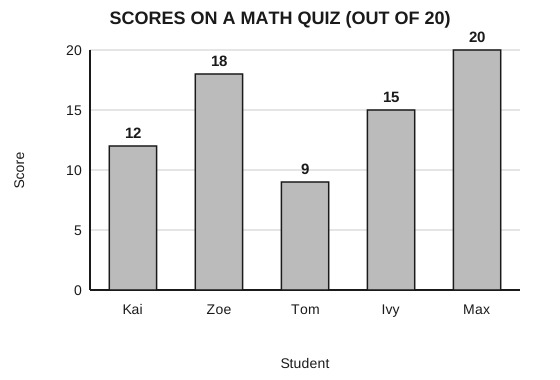
The bar graph shows five students' scores on a math quiz. What is the range of the scores?

A11
B9
C12
D20

Go on to the next page.

22.

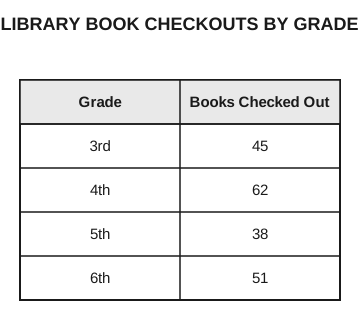
According to the table, how many books were checked out by 4th grade?
A38
B45
C51
D62
23.

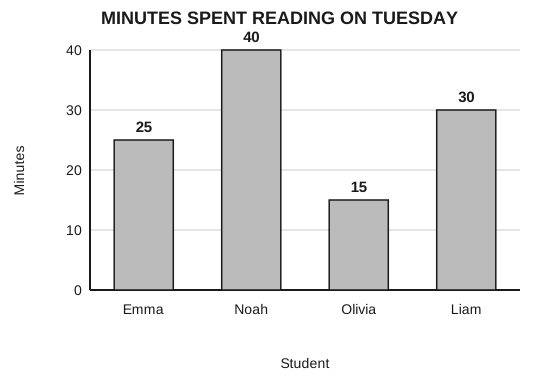
According to the bar graph, how many more minutes did Noah read than Olivia?
A10
B25
C15
D40
24.

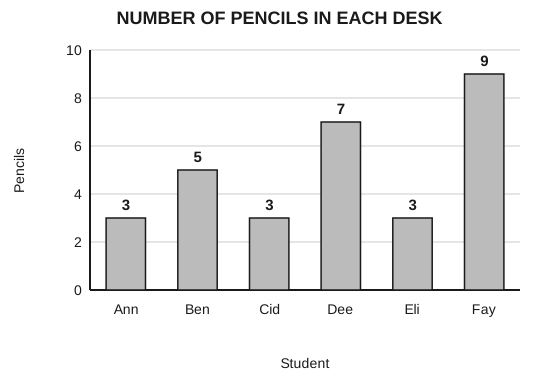
The bar graph shows the number of pencils in six students' desks. What is the mode of this data?

A4
B5
C6
D3

Go on to the next page.

25.

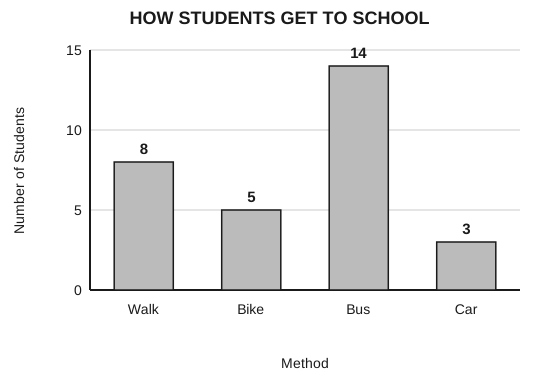
The bar graph shows how students get to school. What is the total number of students shown in the graph?

A14
B30
C22
D27
26.

A rectangular box has a length of 4 inches, a width of 3 inches, and a height of 2 inches. What is the volume of the box?

A52 cubic inches
B24 cubic inches
C12 cubic inches
D9 cubic inches
27.

A designer cuts a rectangular tile that is longer than it is wide, so it is not a square. How many lines of symmetry does the tile have?

A4
B2
C1
D0
28.

In woodshop, a student opens the two parts of a hinge so they form an angle that measures 158 degrees. Based on its measure, what type of angle is it?

AAcute angle
BObtuse angle
CRight angle
DStraight angle
29.

A rectangle has an area of 48 square inches and a width of 6 inches. What is the length of the rectangle?

A8 inches
B288 inches
C42 inches
D6 inches
30.

The three angles inside a triangle always add up to 180 degrees. A triangle has two angles that measure 50 degrees and 70 degrees. What is the measure of the third angle?

A240 degrees
B120 degrees
C70 degrees
D60 degrees

STOP. If you finish before time is called, check your work in this section only.

Essay · 30 minutes · unscored

If you could learn to do any new skill, what would it be and why?

STOP. If you finish before time is called, check your work in this section only.

Answer sheet

Fill in one bubble per question. Essay: use the lined page.

Verbal Reasoning
1ABCD
2ABCD
3ABCD
4ABCD
5ABCD
6ABCD
7ABCD
8ABCD
9ABCD
10ABCD
11ABCD
12ABCD
13ABCD
14ABCD
15ABCD
16ABCD
17ABCD
18ABCD
19ABCD
20ABCD
21ABCD
22ABCD
23ABCD
24ABCD
25ABCD
26ABCD
27ABCD
28ABCD
29ABCD
30ABCD
31ABCD
32ABCD
33ABCD
34ABCD
Quantitative Reasoning
1ABCD
2ABCD
3ABCD
4ABCD
5ABCD
6ABCD
7ABCD
8ABCD
9ABCD
10ABCD
11ABCD
12ABCD
13ABCD
14ABCD
15ABCD
16ABCD
17ABCD
18ABCD
19ABCD
20ABCD
21ABCD
22ABCD
23ABCD
24ABCD
25ABCD
26ABCD
27ABCD
28ABCD
29ABCD
30ABCD
31ABCD
32ABCD
33ABCD
34ABCD
35ABCD
36ABCD
37ABCD
38ABCD
Reading Comprehension
1ABCD
2ABCD
3ABCD
4ABCD
5ABCD
6ABCD
7ABCD
8ABCD
9ABCD
10ABCD
11ABCD
12ABCD
13ABCD
14ABCD
15ABCD
16ABCD
17ABCD
18ABCD
19ABCD
20ABCD
21ABCD
22ABCD
23ABCD
24ABCD
25ABCD
Mathematics Achievement
1ABCD
2ABCD
3ABCD
4ABCD
5ABCD
6ABCD
7ABCD
8ABCD
9ABCD
10ABCD
11ABCD
12ABCD
13ABCD
14ABCD
15ABCD
16ABCD
17ABCD
18ABCD
19ABCD
20ABCD
21ABCD
22ABCD
23ABCD
24ABCD
25ABCD
26ABCD
27ABCD
28ABCD
29ABCD
30ABCD